



Web AR is a technology that allows you to easily experience AR (Augmented Reality) using a smartphone's built-in web browser, such as Safari or Google Chrome. There is no need to download a dedicated app; AR content can be easily displayed using links such as 2D barcodes or AR markers.
The use of Web AR has been increasing in recent years, and it is used in a variety of industries, from marketing and advertising to education.
In this article, we will explain the features of Web AR, which allows anyone to easily experience augmented reality, how it differs from AR apps, and various use cases
Contents
What is Web AR?
Web AR is a technology that allows you to experience AR content on a smartphone or tablet browser.
While experiencing AR through an app requires downloading a dedicated app, the greatest feature of Web AR is that it can be accessed via a two-dimensional barcode or URL.
Users can experience AR for free and easily. For example, Web AR is used in a variety of situations, such as placing furniture or interior products in your room on an e-commerce website before purchasing them, or taking photos with a photo frame that recognizes faces.
If you would like to know more about AR, please read this related article
Features of Web AR
Device-independent
Since there is no need to install a dedicated app, it is not dependent on the type or specs of the device. Anyone with a mobile device can participate, making it possible to provide an experience to a wide range of users
Easy to participate
Web AR can be easily experienced by simply scanning a two-dimensional barcode or AR marker with a device. There is almost no prior preparation or setup required, making it easy for users to participate
Can be used in a wide range of fields
Web AR is being used in a wide range of industries, including retail, tourism, real estate, education, and entertainment.
For example, it can solve problems in a variety of fields, depending on the plan, such as holding an AR stamp rally event using location information, or allowing users to experience a brand story recreated in 3D models by activating AR via a 2D barcode printed on a beverage package.
How Web AR works
Web AR is created using languages such as JavaScript and HTML, and uses device sensors and camera functions specialized for Web AR to overlay virtual objects on the real world. There are various types, including markerless types that directly recognize the environment using AI, and types that are activated by reading specific 2D codes or markers
Differences from AR apps
What is an AR app?
AR apps are applications that can be installed on smartphones or tablets to overlay virtual objects and information onto the real world
The difference between Web AR and AR apps
Easy access
Web AR allows users to easily experience AR by simply scanning a 2D barcode or AR marker. In contrast, AR apps require users to download them in advance, making access more difficult.
In situations where many users participate, such as event promotions, Web AR is easier to participate in and is expected to increase the number of users.
Development period and costs
Web AR uses browser technology such as JavaScript and WebGL, so it can be developed in a shorter time and at a lower cost than app development.
AR apps tend to have higher development costs and take longer to release. On the other hand, they are highly customizable and can achieve advanced technology.
Target audience and purpose of use
Web AR requires no installation and can be accessed with just a smartphone, so it can reach a wide range of people, regardless of age or gender. This makes it ideal for temporary campaigns and promotions.
AR apps are effective for initiatives that require continuous use or advanced functionality. For example, AR apps perform better than Web AR for games and educational apps.
Offline use
To use Web AR, you need to be connected to the internet and always be online.
However, with AR apps, once downloaded, some functionality can be achieved offline. AR apps are convenient when using AR at travel destinations or event venues where internet connection is poor.
AR app features
Available offline
Once you download the app, some of its features can be used offline. You can use pre-saved data to experience AR even in places without a connection
High functionality
Utilizing a smartphone's camera, AR can provide highly accurate AR experiences.
In games and simulation apps, AR apps can reproduce complex 3D renderings, allowing characters to appear and move around in real space and interact with virtual environments in real time. It
can also capture user logs, allowing developers to perform analysis based on the data.
Dedicated functions can be implemented
AR app development is facilitated by AR development platforms such as Apple's ARKit and Google's ARCore, which provide developers with the ability to render 3D objects, design their own interactions, and offer a high degree of customization
Types of Web AR
2D barcode/AR marker
The simplest way to launch Web AR is by using a 2D barcode or AR marker. With this method, you can launch AR and enjoy the content simply by scanning the 2D barcode or AR marker with your mobile device's camera.
For example, you can access related content simply by scanning a 2D barcode embedded in product packaging. User operation is simple, making it easy to implement.
Markerless
Markerless technology is a technology that overlays tactile information and 3D objects onto camera images without requiring specific 2D barcodes or AR markers. Location-based GPS, plane recognition, and object recognition technologies are also types of markerless technology. It is primarily used in spatial recognition technology using smartphone sensors and AI, and a technology called VPS is key. It
is also characterized by its high degree of freedom, as it allows for a flexible AR experience depending on the user's current location and situation.
However, compared to 2D barcodes/AR markers, they have the disadvantage of higher development costs and technical hurdles.
They require real-time recognition and tracking of the environment and objects, and require the analysis of camera images and depth sensors. In some cases, they require the use of AI algorithms, making development more complex.
Another challenge with markerless technology is that it must operate with the same quality across devices with different capabilities and sensors, such as various smartphones and tablets. The development and testing required to ensure this compatibility is time-consuming and costly
Immersive
Immersive AR is a type of Web AR designed to provide a highly immersive experience. It uses advanced 3D graphics and spatial tracking to create an environment where reality and virtuality blend together. It
is characterized by its high level of interactivity and is widely used in games and entertainment. However, development costs can be high and it may require high-performance devices to operate.
Immersive Web AR is used to experience things like making dinosaurs appear in a museum when you hold your smartphone over it, or to have artists perform in a virtual space at music events
Advantages and disadvantages of Web AR
Each type of Web AR has its own advantages and disadvantages, so when using it, you need to consider the impact it will have
Benefits of Web AR
The biggest appeal of Web AR is its ease of access. Users can experience AR immediately without installing a dedicated app.
There's no need for users to install apps or apply updates to access AR content; it can be completed using just a web browser. This makes the AR experience easy, making it easy to use even for beginners with little knowledge.
It also allows for a wide range of users to be reached. Web AR has lower development costs than dedicated apps, and maintenance and update costs are also reduced.
App development requires development for each platform, such as iOS and Android, which requires development, testing, and update work each time.
However, because Web AR uses a browser, it is not dependent on a specific platform and one version can be applied to all devices, making it more cost-effective.
Web AR runs on a web browser, allowing users to experience AR on a variety of devices, including their smartphones and tablets. Because AR content is not dependent on specific hardware or software, it can reach a wide range of target audiences. It
also works well with social media, allowing users to easily post content. It can also generate buzz with topical projects.
Disadvantages of Web AR
Web AR may have limited functionality compared to AR apps. In particular, performance may be inferior to the app experience when it comes to 3D rendering accuracy and complex interactions.
Apps can utilize the full performance of the device and provide more advanced effects and interactions. However, because Web AR runs through the browser, processing power is limited and it may be difficult to reproduce complex simulations and high-precision 3D graphics.
Another disadvantage is that an internet connection is required. Since a network connection is required at all times, it depends on the usage environment. If the communication conditions are poor or the connection is unstable, the performance of the AR content may be reduced. This can be a factor in avoiding the use of Web AR depending on the region and infrastructure environment
Web AR usage examples by scene
Web AR is particularly effective for promotions, sales promotions, and improving customer experience due to its ease of access and simplicity. It
is also used in a wide range of situations, including business, tourism, and retail. We will introduce a wealth of use cases in various industries to show how Web AR is being used.
Business scene
Business Card AR

Business Card AR, one of the services offered by AR Works, is a technology that allows you to experience AR content by reading the 2D barcode embedded in a business card with your smartphone. By introducing this technology, business cards become more than just pieces of paper; they become a catalyst for two-way communication with customers and business partners
For example, by scanning a 2D barcode, you can display a self-introduction video, portfolio, or a video introducing your company's services. This not only makes a strong impression when exchanging business cards, but also helps close the gap between you and the person you're meeting for the first time. Business card AR is also particularly suited to sales professionals, as it has the advantage of making conversations more lively by showing videos introducing products and project examples
Furthermore, you can also use business card AR as a promotional item for your products. By distributing business cards, you can let people experience AR on the spot and draw interest in your products and services. This is also an effective differentiation tool at exhibitions and business meetings, and has the effect of making them memorable. It makes it easier to communicate your products and services because you can present them visually
Retail industry
ASAHI Happy Project
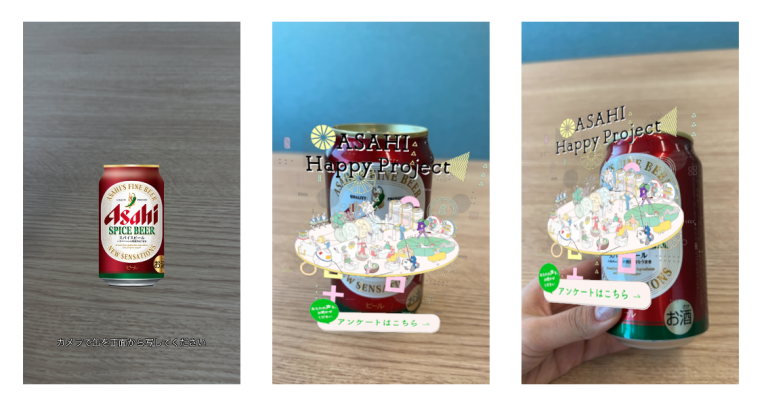
The ASAHI Happy Project is a website that test sells new Asahi Beer or Asahi Soft Drinks products in limited quantities. To coincide with the release of limited-edition products, AR measures are being implemented with the aim of improving survey response rates.
After scanning the two-dimensional barcode on the AR promotional flyer, users hold their device over the product, and the logo and illustrations begin to move. In addition, a button that takes users to the product survey is also displayed, allowing them to respond to the survey.
AR technology can provide a sense of "fun" and "newness," making it possible to reach customers who are reluctant to take surveys.
Another way to do this is to place a 2D code on product packaging or in-store promotional displays, allowing customers to use their smartphones to view a 3D model of the product and experience how it will look in use.
This method is being used to give customers an experience similar to that of purchasing in a store, especially as online shopping becomes mainstream.
Utilizing AR in promotional campaigns can also increase engagement between brands and customers. For example, by offering AR games or lotteries to customers who purchase a specific product, you can encourage repeat purchases of the product
source:
sightseeing
Tomioka Silk Mill
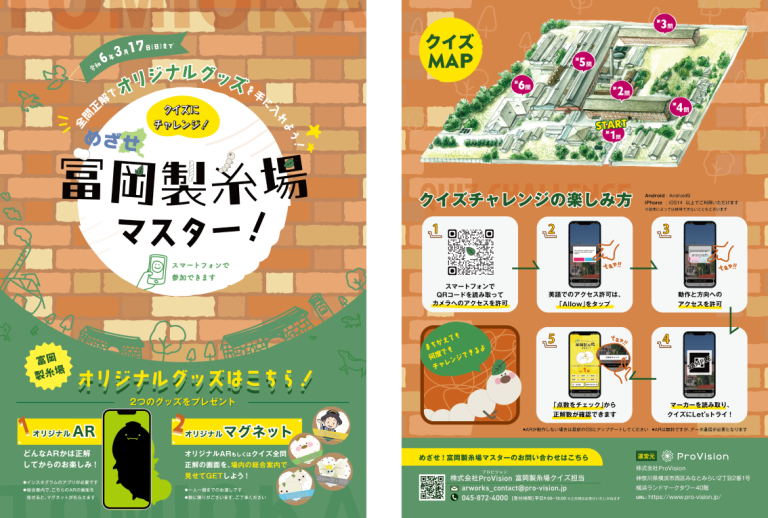
In the tourism industry, Web AR is gaining attention as a new way to communicate the appeal of tourist destinations. Tomioka Silk Mill is a historic silk mill established in Tomioka City, Gunma Prefecture, and Japan's first full-scale mechanized silk mill. It is a representative tourist spot in Gunma Prefecture, attracting approximately 300,000 visitors annually.
AR was introduced to target young people and families, helping them to enjoy their tour of the facility. 2D codes have been placed at various spots within the Tomioka Silk Mill, and visitors can take part in an AR quiz by scanning them with their smartphone. The aim is to get all the questions right, which increases tourist engagement.
There are other uses for AR in the tourism industry. By scanning QR codes at tourist attractions, AR can be used to recreate the past appearance of historical buildings, or the names and descriptions of famous scenic spots can be visually overlaid, making the tourist experience more in-depth and memorable
Furthermore, by incorporating Web AR into tourist guidebooks and maps, it is possible to provide a system that allows visitors to virtually experience a destination in advance on their smartphones. This technology is also being used to promote local tourist destinations, and is an important tool, especially for regions looking to increase visitor numbers
source:
real estate
Inserted flyer
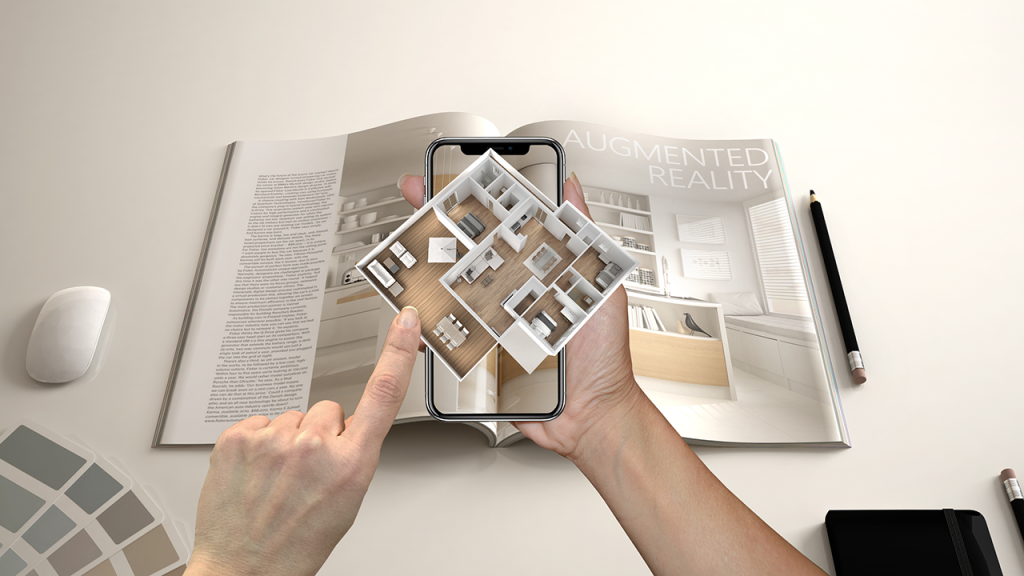
In the real estate industry, one way to utilize Web AR is to incorporate AR content into property inserts. This method allows customers to experience a 3D model or virtual tour of the property by scanning a two-dimensional barcode printed on the flyer with their smartphone. This is targeted at customers who are considering purchasing.
There are no time or distance constraints, so they can check the details of the property at any time without having to actually visit it.
By registering the data, even if the property is not yet completed, customers can see the finished image in 3D, which will make a strong impression on them
In addition, using AR content allows customers to experience the property's interior, facilities, and even the surrounding environment in a realistic way, which increases their desire to purchase
Sports teams
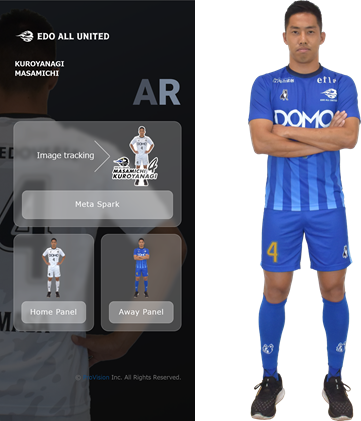
Sports teams are using web AR to target their fans. To increase fan engagement, they offer services such as scanning a QR code at a game venue to display a 3D model of their favorite player on the screen, or recreating memorable moments from the past through AR.
These services increase fan satisfaction and play a major role in improving brand loyalty.

Entertainment
NoMaps2024
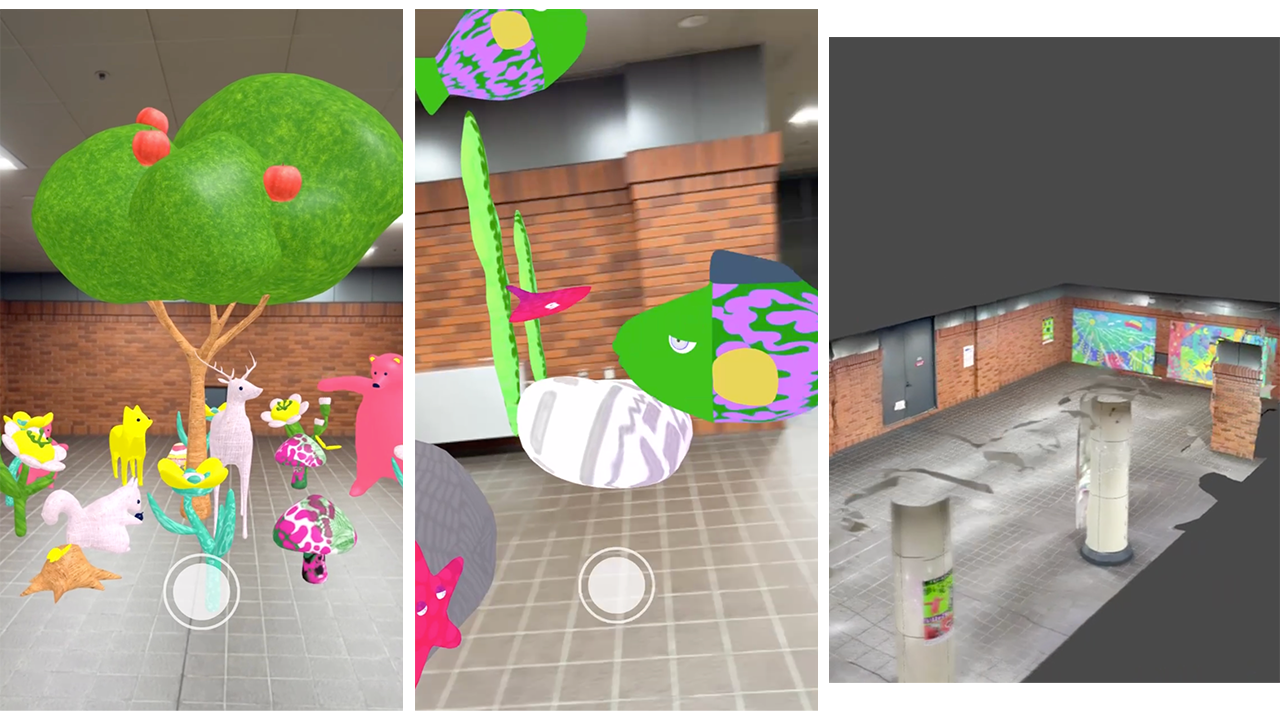
The entertainment industry is increasingly using interactive AR experiences to create an immersive experience
The "Ocean and Forest AR Exploration Event" was held at the creative event "NoMaps2024" in Sapporo, Hokkaido.
By scanning the 2D barcode on the poster, mysterious sea and forest creatures appeared in the real world through AR, dancing and swimming. You could approach or look around while holding your smartphone, try your hand at a game of finding items, and enjoy taking commemorative photos. This
event offered a fun experience for everyone, from art lovers to families.
source:
Educational scene
Google Expeditions
The use of web AR, a cutting-edge technology, is rapidly expanding in the field of education. In particular, Google Expeditions' AR technology is revolutionizing the educational field by making learning more interactive and engaging. For
example, students can experience Earth history and scientific phenomena in the classroom using AR, deepening their visual learning without having to physically touch the materials. Such experiences provide learning that cannot be achieved through textbooks alone, deepening students' understanding.
Additionally, the creation of educational apps and tools using web AR technology is on the rise, attracting particular attention in STEM (science, technology, engineering, and mathematics) education.
By displaying 3D models using web AR in a browser, students can visually understand complex scientific phenomena and engineering concepts. Web AR allows students to intuitively learn content that is difficult to grasp using regular teaching materials, deepening theoretical understanding and improving learning outcomes.
These Web AR tools can be used in a browser without the need to install a dedicated app, making them easy to access and easier to introduce to a wider range of educational institutions.
For example, they can display chemical element models in 3D or interactively experience historical events, allowing learners to learn with their own hands.
By providing students with real-time feedback, they can deepen their understanding at their own pace, which is expected to increase motivation to learn in educational settings and improve the quality of education
summary
Web AR is a technology that allows you to experience AR more easily than AR apps. It can be displayed on the web browser installed on your smartphone, so there is no need to go through the trouble of launching AR.
In addition, development can be done at a relatively low cost and in a short period of time, so the barrier to implementation is low.
AR is already being used in a wide range of situations, such as introducing AR business cards and brochures in business, and holding stamp rallies as part of event plans. In recent years, AR has also been adopted in the field of education, taking advantage of its visual clarity and high level of realism
With further advances in technology, it is expected that AR will be used in an even wider range of fields
If you are having trouble attracting customers or marketing, why not consider this as one of your new projects?
Leave the implementation of AR to AR Works

AR Works supports businesses and stores in promoting, attracting customers, and branding through innovative AR solutions
We provide one-stop services that meet a wide range of needs, including ideas to liven up events, experiential content that makes products more attractive, and original projects that support the revitalization of tourist destinations and local areas
For more information, please visit the AR Works service site
Related useful materials can be found here
Introducing AR Works achievements
Please see below for examples of projects created with AR Works. We introduce a variety of scenarios, including promotions, events, and customer awareness, so please take a look
▼List of achievements | AR Works
https://promotion.ar-works.jp/achievement



![[AR experience available] The dinosaurs start moving on the spot! Examples of use of AR dinosaurs and their introduction points](https://promotion.ar-works.jp/wp-content/uploads/2025/07/icatch.jpeg)
